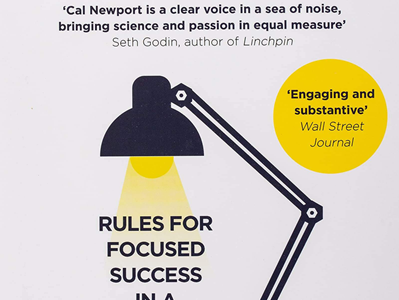
Book Title: Deep Work
Author: Cal Newport
Genre: Personal Development / Productivity
Age Rating: 14+
Overview:
Deep Work: Rules for Focused Success in a Distracted World by Cal Newport presents a compelling case for cultivating deep focus in a world increasingly dominated by distractions. Newport argues that the ability to perform “deep work” — cognitively demanding tasks in a state of distraction-free concentration — is becoming increasingly rare and increasingly valuable in the knowledge economy. This book blends actionable strategies with philosophical insights, making it a must-read for anyone aiming to thrive professionally in the digital age.
Summary / Digest:
Cal Newport opens Deep Work by defining two kinds of work: Deep Work and Shallow Work. Deep Work involves high concentration, skillful thinking, and the creation of new value. Shallow Work, on the other hand, includes tasks that are non-cognitively demanding, often done while distracted — like answering emails or checking social media. Newport argues that while most knowledge workers today are trapped in shallow work cycles, the ability to perform deep work is the key to success in a complex, fast-moving economy.
The book is structured in two parts. Part One lays the philosophical groundwork, making a case for why deep work is valuable, rare, and meaningful. Newport explains that technological shifts — the internet, social media, instant messaging — have fragmented our attention spans. While these tools have some utility, they undermine our ability to work deeply. Newport urges readers to see their attention as a finite resource and to guard it aggressively.
He draws from neuroscience to explain that the brain strengthens the circuits it uses most. If one spends most of the day in shallow, fragmented tasks, the brain becomes less capable of deep thinking. Conversely, if one deliberately practices concentration, the brain becomes better at it. Newport points to historical and modern examples — Carl Jung, Bill Gates, and even successful authors like J.K. Rowling — who retreat into focused environments to accomplish meaningful work.
In Part Two, Newport shares four key “rules” for cultivating a deep work habit:
1. Work Deeply
Newport acknowledges that building deep work into one’s life is difficult. Distractions, social norms, and professional obligations all pull us away from sustained focus. He offers several strategies for embedding deep work into daily life. These include:
- Monastic Philosophy: Maximize depth by eliminating or radically minimizing shallow obligations. This might be suitable for writers, scholars, or solo creatives.
- Bimodal Philosophy: Divide time into clearly defined deep work and shallow work segments (e.g., professors who do deep work in semesters and shallow work in breaks).
- Rhythmic Philosophy: Create a daily rhythm for deep work — perhaps by setting aside 2–4 hours every morning.
- Journalistic Philosophy: Fit deep work into one’s schedule whenever possible, like a journalist writing in between assignments. This requires advanced skill in transitioning between modes.
To make deep work effective, he emphasizes the need for rituals and routines. For example, one should know where they will work, for how long, and what rules will govern the session. He also suggests leveraging “grand gestures” — radical acts like renting a hotel room for a weekend — to trigger focus and productivity.
2. Embrace Boredom
In our always-on culture, most people habitually reach for their phones during any idle moment. Newport warns that this constant stimulation erodes our ability to concentrate. He suggests training your brain for boredom by resisting the urge to fill downtime with distractions.
He introduces the concept of productive meditation: using walks or mundane tasks to mull over complex problems. This strengthens one’s “attention control” and makes transitions into deep work easier. The key is to stay focused on one problem without drifting into unrelated thoughts or stimuli.
3. Quit Social Media
Newport isn’t anti-technology, but he is critical of the mindless adoption of tools that offer minimal benefit. He introduces the Craftsman’s Approach to Tool Selection: only use a tool if it offers substantial benefits to what you truly value.
Rather than asking, “What’s the worst that could happen if I don’t use Twitter?” Newport flips the question: “Is Twitter significantly helping me achieve my goals?” He encourages readers to try 30-day digital detoxes and reevaluate which tools deserve to be reintroduced.
4. Drain the Shallows
Since shallow work can’t be completely eliminated, Newport suggests minimizing it. This involves auditing your schedule, eliminating unnecessary meetings, batching emails, and being stingy with your time. One of his more radical suggestions is to schedule every minute of your workday — not to lock yourself into a rigid plan, but to heighten awareness of how you use your time.
Newport also advises creating clear boundaries between work and personal life. A shutdown ritual at the end of the workday helps reinforce the mental barrier and preserves energy for the next day.
The digest concludes with Newport reiterating that the world is becoming increasingly complex, and the few who master the ability to focus without distraction will dominate their fields. In an age of shallow consumption, deep work is a competitive advantage and a path to satisfaction.
Top 3 Takeaways:
- Deep Work is becoming increasingly rare, yet it’s the skill that will help you thrive in the knowledge economy.
- Structured routines and rituals are essential for entering and sustaining deep work states.
- Digital minimalism and conscious time management can dramatically improve your focus and productivity.
Pros:
- Actionable advice with clear frameworks
- Grounded in both research and real-world examples
- Highly relevant in today’s distraction-driven world
Cons:
- Can feel repetitive in parts
- May appear rigid or extreme for casual readers
Recommended For:
Professionals, students, freelancers, writers, and entrepreneurs seeking to maximize productivity and do more meaningful, high-impact work.